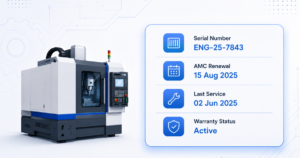
AMC Renewal Leakage: How Machinery Companies Are Losing Service Revenue Without Knowing It
Quick Answer
AMC management software tracks annual maintenance contracts for machinery businesses — renewal dates, service schedules, contract values, and customer records — in one connected system. When a contract nears expiry, the software alerts the right person and triggers a renewal workflow automatically. For most machinery companies, moving from Excel-based AMC tracking to a dedicated CRM means fewer missed renewals, more predictable service revenue, and management visibility into every active and expiring contract.
The AMC Leakage Problem Every Machinery Business Recognises
One person owns the AMC sheet. Usually it is someone in the service team — detail-oriented, has been doing it for years, knows every customer by name. The system works because it is simple.
This works until it doesn’t.
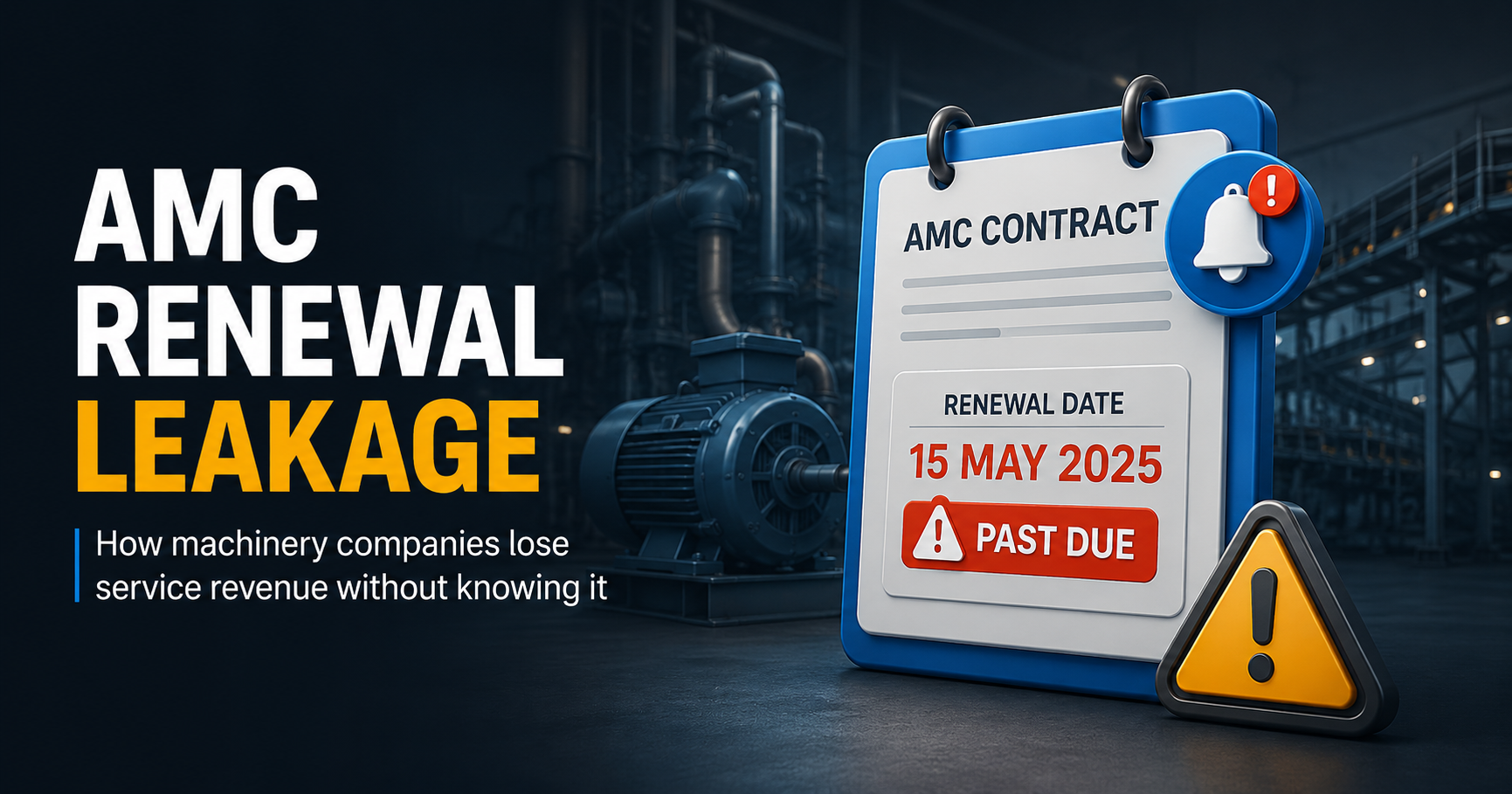
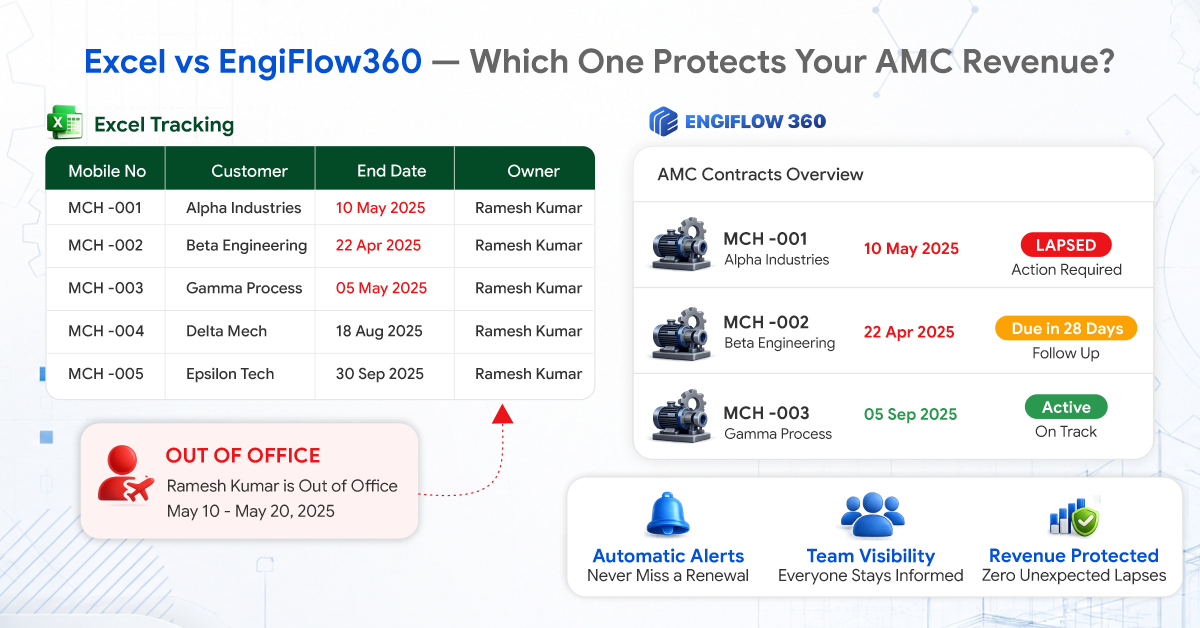
That person goes on leave for ten days. In that gap, three renewal dates pass without a reminder. By the time someone picks up the sheet again, those contracts have lapsed. One customer has already signed a maintenance agreement with a local service provider. This is exactly the problem AMC management software is built to solve — and the gap between machinery businesses that capture service revenue predictably and those that lose it without noticing.
This is AMC revenue leakage. It is quiet. A few missed renewals per quarter. Customers who would have renewed but never received a timely offer. Service revenue that looks stable on paper but is lower than it should be. AMC management software exists to solve exactly this problem — and it is the difference between a machinery business that captures service revenue predictably and one that loses it without noticing.
Where AMC Revenue Actually Leaks — Four Specific Points
AMC leakage is not random. It happens at the same four points in almost every machinery business that manages contracts outside a dedicated system.
- The renewal reminder has a single owner. In most companies, AMC renewal reminders live in the Excel file maintained by the service head, in a shared calendar entry set when the contract was first signed, or in the memory of the person who manages the account. When that person is on leave, handling a service emergency, or simply occupied with other priorities, the reminder slips. There is no system catching it.
- The service team and the sales team do not talk. A field engineer completes a service visit and closes the job on WhatsApp. The customer’s machine ran well. The engineer marks it done and moves to the next call. Nobody informs the sales team that this machine’s AMC expires in six weeks. The sales team has no visibility into which machines are under contract and which are approaching renewal. They find out when the customer calls — which is rarely the best moment to start a commercial conversation.
- Management cannot see the full AMC picture. When the MD asks how many AMC contracts are active this quarter and what the renewal value looks like, the answer requires pulling the Excel file, chasing the service head, and assembling the data by hand. By the time the picture is clear, some of those contracts may have already lapsed.
- There is no automatic follow-up. When a contract is sixty or ninety days from expiry, someone needs to send the renewal offer. In a system built on spreadsheets and WhatsApp, that depends entirely on whoever remembers. Which means, in practice, it sometimes does not happen at all.
Managing more than fifty machines in the field?
Talk to our team about how EngiFlow360 handles AMC tracking and renewal automation for machinery businesses. We will walk you through the workflow before you commit to anything.
What Changes When AMC Management Software Replaces Excel
This is not a question of discipline. It is a question of structure. Moving AMC management to a CRM built for machinery businesses changes four things at the workflow level — not gradually, from the first week the system is live.
- Every contract is connected to the machine. Not a row in a spreadsheet — a record linked to the machine serial number, installation date, service history, customer contact, and contract value. When someone asks about the AMC status of a specific machine, the answer is in the system: who the customer is, when the last service visit happened, when the contract expires, and what the renewal value is.
- Renewal alerts go out automatically. The system flags a contract sixty days before expiry and assigns a renewal task to the right person. The reminder is not on a calendar that may or may not be checked. It is in the workflow, with context attached — so the renewal conversation can happen with full information, not a scramble to remember the account history. The system owns the reminder, not a person.
- The service team and sales team see the same data. When a field engineer closes a service ticket, the machine record updates. The sales team can see that this machine’s contract is approaching expiry and that the last visit resolved cleanly. The renewal conversation has context before it starts. Customers do not have to repeat the same information to three different people.
- Management has a live view of the AMC pipeline. Active contracts, renewal value due this quarter, contracts expiring in the next thirty, sixty, and ninety days — available without chasing anyone. Management can review the service revenue pipeline the same way they review the sales pipeline: from a dashboard, on any device, at any time.
How EngiFlow360 Handles AMC Management Software for Machinery Businesses
EngiFlow360 is built specifically for machinery and engineering businesses. AMC management software functionality is a core part of how the system works — not a workaround built on top of a generic CRM.
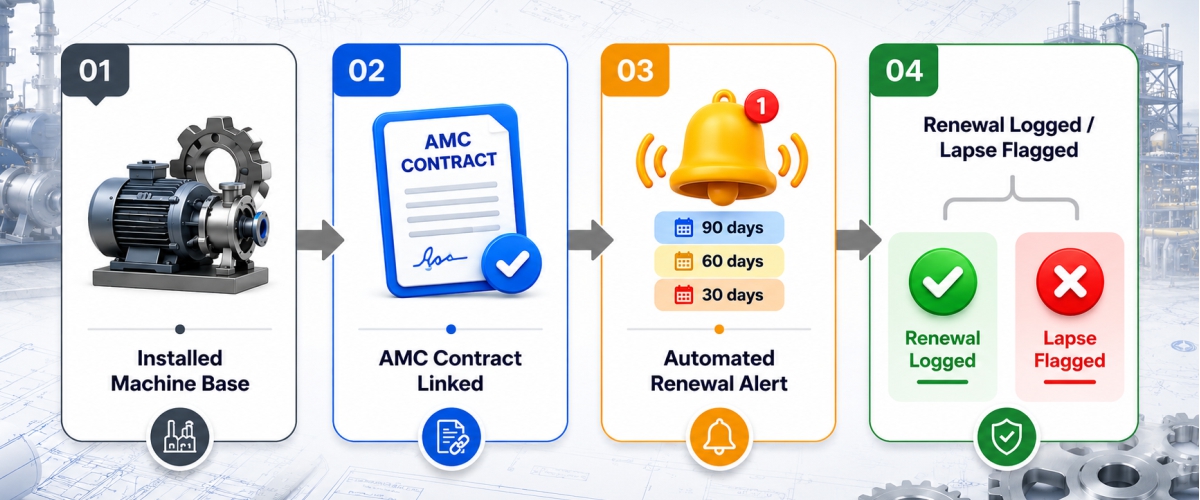
When a machine is installed and commissioned, the AMC contract is created and linked to the machine record. Contract start date, end date, terms, and renewal value sit alongside the machine serial number, installation history, and service records in one place. There is no separate sheet to maintain. There is no second system to update.
At sixty days before expiry, the system triggers a renewal alert. A task is created and assigned to the account manager responsible for that contract. The service history for that machine is attached — how many visits were made, what was raised, how quickly issues were resolved — so the renewal conversation can start from facts, not guesswork.
When the renewal is confirmed, the contract updates automatically. The machine record reflects the new AMC period. The dashboard refreshes. Service team and sales team both have current information.
For machinery businesses operating through dealer networks, EngiFlow360 handles dealer-managed AMC contracts with the same visibility and the same renewal workflow — so the channel does not create a blind spot in your service revenue picture.
See the AMC management workflow in EngiFlow360
A 30-minute walkthrough with our team in Ahmedabad. We will show you exactly how AMC tracking, renewal alerts, service integration, and the management dashboard work for a machinery business like yours.
The Business Case for AMC Management Software
AMC revenue is recurring and predictable — which is precisely why losing it quietly is so costly. A missed renewal is not just a lost transaction. It is a gap in the service relationship and an opening for a competitor to step in during the unmanaged period. AMC management software exists to close that gap before it opens.
The machinery businesses that move AMC management from Excel to a dedicated system report a consistent shift: renewal conversations happen before contracts lapse, not after. Service teams and sales teams work from the same information. Management can see what is expiring next quarter without assembling the data by hand on a Friday afternoon.
The transition does not require a large team or a long implementation. For standard AMC tracking and renewal workflows, EngiFlow360 is configured and ready within fifteen to thirty days when machine records, contract data, and user access are prepared. Your service and sales teams are trained on the renewal workflow before go-live. The installed base data migrates into the system cleanly.
The question most machinery businesses ask is not whether AMC management software makes sense — they already know the Excel approach is not scaling. The question is whether the setup effort is worth it. For a business with more than fifty machines in the field and any meaningful AMC revenue, the answer is consistent: the leakage costs more than the software.
EngiFlow360 is built for machinery and engineering businesses managing AMC contracts, service teams, and dealer networks.
Request your 15-day pilot — our team in Ahmedabad configures your AMC tracking and renewal workflow before you go live. No commitment required during the pilot.