Why Your Sales and Service Teams Will Feel the Difference on Day One

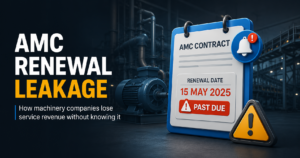
One person owns the AMC renewal sheet. Usually it’s someone in the service team — detail-oriented, has done it for years. This works until it doesn’t. That person goes on leave for ten days. Two renewal dates pass with no reminder sent. By the time someone reopens the sheet, one customer has already called a competitor for a quote.
Quick Answer
Machinery CRM benefits are the operational gains a manufacturer feels immediately after moving sales and service workflows off Excel and WhatsApp into one connected system — faster lead response, quicker quotations, structured service dispatch, and AMC renewals that don’t depend on one person remembering. For machinery businesses tracking AMC manually, this is where recurring service revenue leaks. A structured AMC workflow inside a CRM stops that leakage before it reaches the MD’s desk.
What Breaks First in a Machinery Business Without a CRM
It’s rarely one big failure. It’s four small ones that compound.
- Leads sit in someone’s inbox or WhatsApp thread until that person remembers to follow up — by which point the buyer has spoken to two other vendors.
- Quotations go out in Word, with no version control, so nobody can tell which copy the customer last saw or whether it matches what was actually discussed.
- Service complaints land in branch-level WhatsApp groups, invisible to anyone above the local team, until a customer escalates directly to the MD.
- AMC renewal dates live in one person’s Excel sheet, with no automated reminder and no backup if that person is on leave, travelling, or has left the company.
This is not a question of discipline. It is a question of structure.
Still Tracking AMC Renewals in Excel?
See how machinery businesses move dealer, service, and AMC tracking into one system.
[ IMAGE PLACEHOLDER 1 ]
Concept: A cluttered WhatsApp service complaint thread next to a clean structured ticket list — visual contrast between chaos and structure
Size: 1200 x 628 px
File name: machinery-crm-benefits-service-complaints-chaos.jpg
Alt text: Machinery CRM benefits shown through structured service ticket tracking versus scattered WhatsApp complaints
Caption: Service complaints without a system disappear into WhatsApp threads. A CRM gives every complaint a status.
Lead Response: From Memory to System
In most machinery businesses, leads come in through calls, exhibitions, dealer referrals, and the website — and they land in different inboxes, owned by different people. A CRM built for machinery CRM benefits means every lead has one owner and one status, visible the moment it’s created. Sales managers stop chasing “did anyone call this back?” over WhatsApp at 7 PM.
Quotation Speed and Version Control
Quotation delay is one of the most common reasons machinery deals slow down. When the quotation process runs through a CRM, version history is automatic — every revision is timestamped and tied to the original inquiry. The system owns the reminder, not a person. Nobody has to remember to follow up three days after a quote goes out; the workflow does it.
Service Dispatch That Management Can Actually See
Service requests in a machinery business rarely arrive cleanly. They come from a site engineer’s phone call, a dealer’s WhatsApp message, or an email from a plant manager. Without a shared system, each request lives wherever it landed — visible to whoever happened to receive it, invisible to everyone else. A structured service ticket workflow gives every request an owner, a status, and an SLA clock that the whole team — not just the person who answered the phone — can see.
AMC and Installed Base: Where Revenue Quietly Leaks
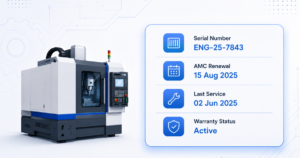
AMC tracking is the clearest place where machinery CRM benefits show up financially. When AMC renewal dates live in a CRM tied to the installed machine base, the system flags upcoming renewals automatically — weeks in advance, not the week they expire. This works until it doesn’t is exactly the line that describes the Excel-sheet version of AMC tracking. It runs fine for years, right up until the one person managing it is unavailable at the wrong moment.
[ IMAGE PLACEHOLDER 2 ]
Concept: AMC renewal calendar with upcoming dates flagged automatically, tied to installed machine record
Size: 1200 x 628 px
File name: machinery-crm-benefits-amc-renewal-tracking.jpg
Alt text: Machinery CRM benefits for AMC renewal tracking linked to installed machine base
Caption: AMC renewals flagged automatically — weeks before they lapse, not the week they expire.
Built for Machinery, Not Retrofitted From Generic CRM
EngiFlow360 handles inquiry to AMC as one connected workflow — see it on a 20-minute call.
Dealer Network Visibility
For machinery manufacturers running a dealer network, visibility usually stops at the dealer’s door. Commission requests, complaint escalations, and service reimbursements move over calls and email with no audit trail. Bringing dealer activity into the same CRM gives the MD’s office a real-time view of dealer performance — without a single phone call to “check status.”
Field Team Access from the Site, Not After It
Sales and service engineers working from customer sites today report back over WhatsApp at the end of the day, if at all. A mobile-accessible CRM means a service engineer logs a visit, updates a ticket status, or checks an AMC date from the customer’s plant — not after returning to office, not the next morning.
What Changes by End of Week One
When sales, service, dealer, and AMC workflows move into EngiFlow360, machinery businesses typically notice three things in the first week: leads have a visible owner instead of sitting in an inbox, service complaints have a status instead of disappearing into a WhatsApp thread, and the MD’s office can pull a pipeline or complaint view without asking five people for an Excel file. EngiFlow360 is built specifically for machinery and equipment companies managing this exact set of workflows — from inquiry and quotation through installation, service, AMC, and installed machine history.
Your Sales and Service Teams Shouldn’t Run on Memory
EngiFlow360 brings inquiry, quotation, service, and AMC into one system your team will actually use.